

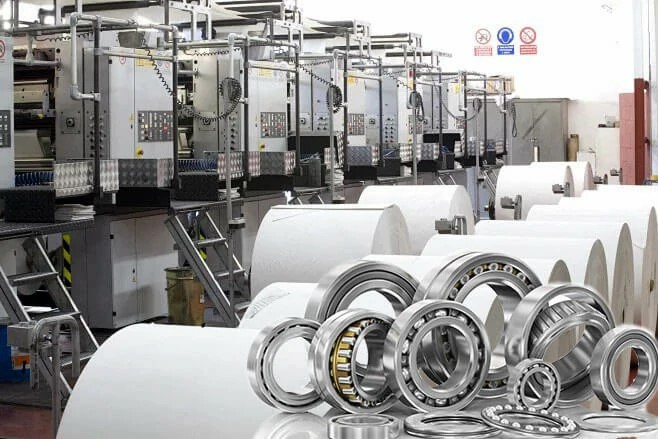
Last week of summer, heat pressed down like a weight inside that Pune plant. Machines hummed - metal arms moving fast along the CNC track, shaping pieces for cars. Looks good on charts, sure. Tech up to date, people trained well, electricity steady without flickers. Every few hours, without warning, the spindle crept out of place - just a hair too far. That tiny jump turned flawless workpieces into waste.
It even had the same part number. But it couldn't withstand the dimensional changes caused by heat in a double shift scenario. That was my "aha" moment. In high-stakes production, your multi-crore duction line is only as reliable as the thin film of steel and lubricant inside your housings.
Frankly, they are the easiest things to ignore. You hear about AI, IoT, and "Industry 4.0" (whatever that buzzword means this week), but none of it will matter if your machines' physical rotation is not perfect. So today, we are going to talk quite extensively about the role Precision Bearings in Manufacturing have as the backbone of industrial efficiency. This is not just about tiny shiny metal balls; it is about survival in a hyper-competitive Indian market where margins are razor-thin and downtime can be a death sentence.
In the Indian manufacturing context, from textile hubs of Surat to heavy engineering clusters of Tamil Nadu, the local mentality to save 15% on spares is quite the temptation. Precision bearings in manufacturing are not just the components that spin. Instead, they are meticulously engineered elements that have a microscopic tolerance level and can endure extremely high speeds and loads.
Some Reynolds Numbers About How Non-Precise Your Choices May Cost You
Standard-grade bearings in places requiring high-precision will not just lower your accuracy but result in losses that are not visible in your profit and loss statement immediately:
The next time you give the green light for a purchase, you must equip to technical prowess, or at least your engineering lead should be talking seriously with you. Physical Specifications and Precision Indicators are not something only the experts should know and in the context of Precision Bearings in Manufacturing the smallest details are the biggest difference.
This is probably the single most important characteristic. A precision bearing, often graded through ABEC or ISO classes, is manufactured to achieve tightest tolerances of the inner and outer rings. Let's put it this way: the runout wobble on a generic bearing is quite likely. At 500 revolutions per minute, you are unlikely to notice it. At 20, 000 revolutions per minute, the wobble is quite literally a hammer that destroys your spindle.
High-purity copper is used for electrical wires to prevent overheating; this is the same for steel used for precision bearings: steel must be 'pure'. Vacuum degassed steel without the presence of micro inclusions is what is talked about here. It can be a tiny speck of impurity that leads to the formation of a crack. Under industrial pressures, the crack extends, resulting in premature failure.
That slick stuff people overlook? It's far more than goop squeezed from a container. Tiny amounts - down to the milligram - matter when things must move with exactness. Too much paste inside a mechanism stirs up resistance, building warmth nobody wants. When there’s too little, bare metal scrapes against its twin. Getting it right separates industry leaders from garage tinkerers.
If you are a plant manager or a business owner, your concern about steel physics is overshadowed by the free cash flow. So, let's talk about money. Precision Bearings in Manufacturing turn out to be a strategic investment, just like a firm faces a dilemma if it wants to build AI internally or purchase it from the shelf, finally, you have to trade the initial cost concerns with the long-term value.
According to a quote from HBS Prof. Iavor Bojinov on AI that goes, "Operational benefits make you more efficient, while strategic benefits can make you more differentiated, " bearings play quite a similar role.
"Fix the machine only after it breaks" approach is still prevalent in most Indian industries. However, the effects of an unplanned stoppage, production loss, labor idle, and the panic buying for spares, are colossal. Precision bearings, by design, offer "predictability." As you comprehend their performance, you can shift towards predictive maintenance whereby parts are changed on condition based on data and not catastrophes.
Indian market is akin to "finding a needle in a haystack" scenario. You have global leaders like SKF, FAG, and NBC but also huge segmented and unorganized sector which is quite skilled in creating counterfeits.
Certifications mean more than filing in a pile of papers. They are one step in the chain of consumer confidence.
Honestly, a partner whose technology is stuck in the 1980s would not be the ideal one for you. Pillow block bearing manufacture nowadays is a high-tech operation. One of the criteria that you can use is to observe a company using automated production lines. Humans make errors, especially when dealing with microns. Automation means that the 1, 000th bearing is indistinguishable from the 1st.
India is expected to play an important role in the world transformation with the government's effort to eventually reach 500 GW clean energy by 2030, which is bound to change our industrial equipment requirements.
Precision Bearings in Manufacturing undergoing changes:
If your supplier is not discussing the trends or R&D for these "emerging opportunities, " then it is highly likely that they are not the right partner for your growth in the long run.
What is the trick here? You cannot simply launch a bearing replacement spree in your facility next day. Planning and stepping is necessary.
The need for an ultra-precise bearing doesn't arise for each conveyor belt. Factory inspection is needed. Which machines hold you back the most? Which ones are associated with the highest cost of failure? For those areas, invest in Precision Bearings in Manufacturing. The spindle, high-speed motors, and precision grinders are the ones on which you should focus.
It is like with copper purity for your server hub. You do not make a compromise there, right? So, the same goes for the steel and lubricant specifications for your bearings. A metallic document to ascertain the supplier's honesty and quality can be requested. With a price 30% lower than market average, can you really afford to buy from the manufacturer without any quality assurance? What part of the manufacturing process was compromised? Steel quality? Heat treatment? Grinding accuracy...
Tapered roller bearings purchase are not like a one-night stand, but something you count on for years. An after-sales support offering supplier can be the most important one. Can they assist your team with the methods of installation? (Did you know that impacting a bearing with a hammer during installation can reduce its lifetime by 50%? Such cases are more common than we'd like to admit). A supplier who educates your crew about proper layout and fit is worth their weight in gold.
I believe that the fascination with new technologies including software, screens, AI clouds, etc. is one that captures us so totally that we often forget about the tangible world. It is quite stubborn. You can have the best slogans or the smartest digital transformation strategy but this will not change the fact that your hardware is failing to meet.
Though, I have witnessed too many initiatives failing at the final stage simply by sacrificing a few thousand rupees on a critical component. The safety and prosperity of your venture are literally determined by the components you choose today.
It's time to stop thinking about a part number only. What you are actually doing when ordering are laying the foundation of a resilient and efficient business, one ready to face the future. A slight difference in price should not lead to the compromise of a foundation.
Trust your instincts, but do a lot of verification. Stick rigidly to standards that can be verified. And, above all, pick a partner who is willing to care about the precision level of your products as much as you are.